
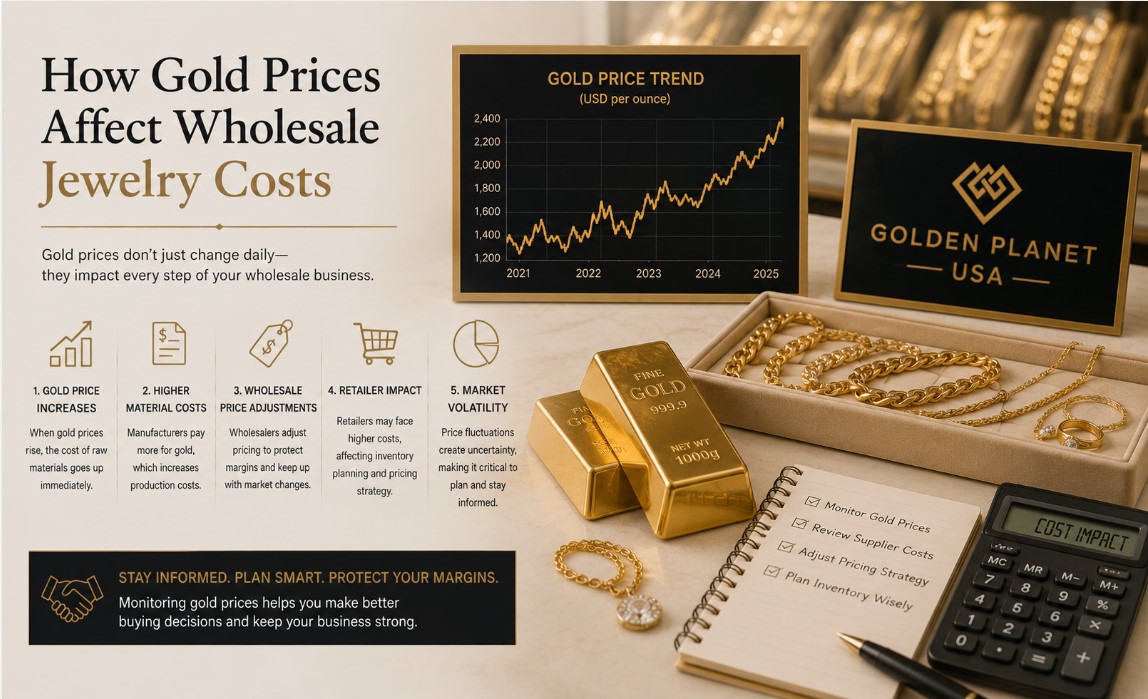
If you’ve bought wholesale gold jewelry in the last two years, you already know the feeling. The same style you reordered last season quietly costs more this season. That’s not a supplier squeezing you. It’s the gold market itself. Understanding how the spot price actually flows into your cost is the difference between reacting to price changes after they hit your invoice and pricing ahead of them.
What “gold price” actually means for your inventory
The gold spot price is the live, per ounce market price of pure gold. It’s the raw material foundation under every solid gold piece you stock. But a finished 14K ring isn’t pure gold. 14K is 58.3% gold, 18K is 75%, 10K is 41.7%, and 21K is 87.5%. So the spot price doesn’t hit your cost dollar for dollar. It hits it in proportion to karat and weight.
A rough way to think about the gold content in any piece:
Metal cost ≈ spot price per gram × gold purity (karat %) × gram weight of the piece
On top of that base sits labor, design, stones if there are any, finishing, and distribution. The metal is the part that moves with the market, which is why heavier and higher karat pieces feel a price run the hardest.
Why this matters more right now than it has in years
Gold has just been through one of the most dramatic runs in its history. To put the last two years in perspective:
- Through 2024, gold established itself above $2,500 per ounce, rising roughly 27% on the year as central banks bought heavily and markets anticipated rate cuts.
- In 2025, the climb accelerated past $3,500 and kept setting records. By some counts, gold hit roughly one new all time high per week across the year.
- Gold started 2025 around $2,624 per ounce and finished the year far higher, then surged past $5,000 for the first time in January 2026, reaching an all time high near $5,589 per ounce on January 28, 2026.
- Since that peak, the price has corrected substantially, trading back in the low to mid $4,000s per ounce by mid-2026.
The headline here isn’t just that gold went up. Gold nearly doubled and then pulled back sharply, which means wholesale costs have been both higher and more volatile than most retailers ever built their pricing models around. These figures reflect widely reported market data through mid-2026. Always confirm the live spot price before finalizing a large order, since a number from even a few weeks ago can already be out of date.
How a rising or falling spot price shows up in your wholesale cost
When gold rises, the effect is immediate and uneven across your assortment:
- The metal portion of every piece costs more, right away.
- Heavier and higher karat items, especially 18K and 21K, rise fastest in absolute dollars.
- Your compare-at and MSRP math gets squeezed if retail prices stay static while cost keeps climbing underneath them.
When gold falls, the relief is real but slower than retailers expect:
- Metal cost eases, but not instantly across existing stock, since inventory bought at higher prices still has to sell through first.
- A dip can be a genuinely good window to place larger stock orders on core styles before the market turns again.
Either way, volatility itself is the real cost. Wild swings make it hard to set stable retail prices, quote customers with confidence, or plan out a season’s buy in advance. This is exactly where understanding the factors affecting gold jewelry prices starts to matter as much as knowing the spot price on any given day, and where how you source starts to matter just as much as what the market is doing.
Five ways retailers protect margins in a volatile gold market
None of this means retailers are just at the mercy of the market. A handful of practical habits make a real difference in how much of a price run actually eats into margin.
- Price in gold content, not gut feel. Know the approximate metal weight and karat of your best sellers so you can see a cost increase coming instead of discovering it on the invoice.
- Favor made-to-order for higher karat and heavier pieces. When you produce to demand, you’re buying gold closer to the moment of sale instead of carrying expensive metal on the shelf while the market moves underneath it. There’s more on this trade-off in a separate piece on made-to-order versus stock jewelry.
- Buy factory-direct to strip out markups. Every middleman between the refinery and your shelf adds a margin on top of an already rising metal cost. Working with a gold jewelry supplier that sells manufacturer-direct gives you the cleanest possible cost basis, without paying for layers of markup you never see itemized. It’s worth reading what factory-backed actually means in jewelry manufacturing if that term keeps coming up in supplier conversations.
- Mix your karats strategically. 10K and 14K carry less gold content, so they absorb spot price spikes better at the register, which is useful for price-sensitive segments when gold is running hot.
- Reorder core stock during dips. When the spot price corrects, that’s the moment to deepen inventory on proven sellers rather than chasing them later at a higher basis.
Getting pricing for gold jewelry right takes more than watching the spot price
None of this is about predicting where gold goes next. Nobody in the trade has that figured out with any real consistency, and the last two years have made that obvious. It’s about building a pricing process sturdy enough to absorb whatever the market does, instead of getting caught flat-footed every time a supplier invoice comes in higher than expected.
The takeaway
Gold’s price is the single biggest variable in what you pay for solid gold jewelry, and after a two-year run to record highs followed by a sharp pullback, that variable is more active than it’s been in a generation. Retailers who understand how gold prices for jewelry actually flow into cost, and who source factory-direct with a smart mix of stock and made-to-order production, turn that volatility from a threat into a planning advantage instead.
Golden Planet USA supplies solid 10K, 14K, 18K, and 21K gold jewelry factory-direct from Turkey, distributed from New York’s Diamond District, with manufacturer pricing and made-to-order flexibility built for exactly this kind of market.
Want a cost basis that starts at the factory, not three markups later?
Request our wholesale catalog to see current stock pricing across 14K and 18K gold jewelry, along with made-to-order options for 10K and 21K pieces. Retailers exploring wholesale gold jewelry for the first time are welcome to schedule a visit to the New York office and compare pricing before committing to a full order.