
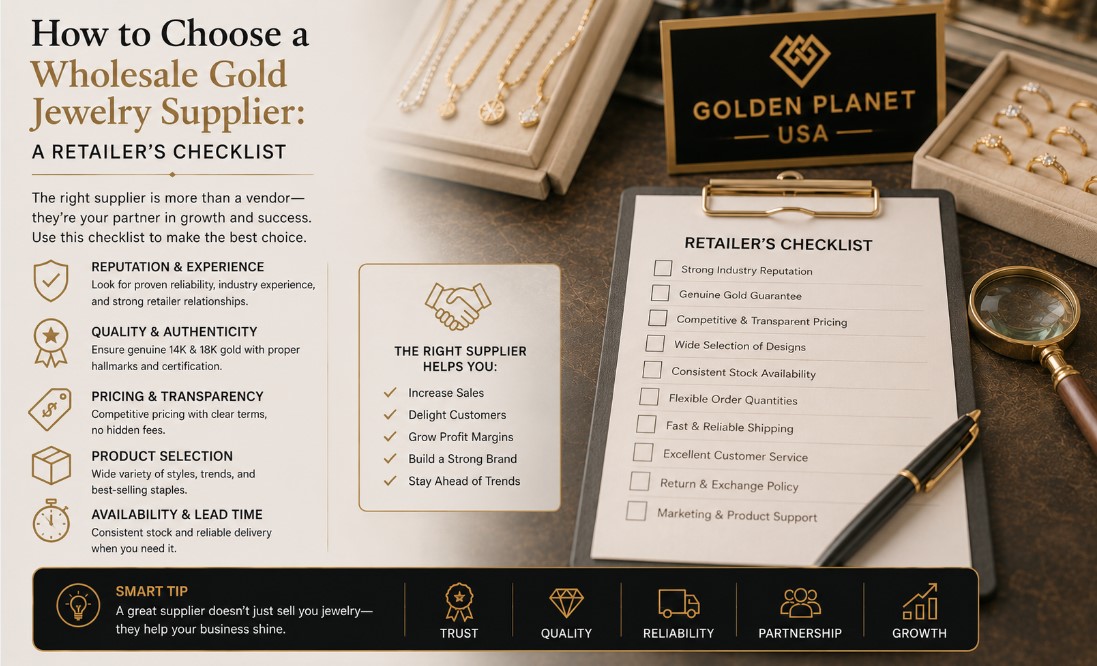
Every jewelry store owner has a story about the supplier who looked perfect on paper and then fell apart after the first order — slow shipping, gold that didn’t match the stamp, or a minimum order quantity that quietly doubled once the invoice arrived. Choosing a wholesale gold jewelry supplier is one of the few decisions that touches almost everything else in your business: your margins, your customers’ trust, and how often you’re restocking instead of explaining a delay.
Here’s what actually matters when you’re vetting one, based on what separates the suppliers retailers stick with for years from the ones they quietly stop calling.
Article Contents
- Why Your Supplier Relationship Makes or Breaks Your Margins
- 1. Verify the Gold Content, Not Just the Marketing
- 2. Ask Where the Jewelry Is Actually Made
- 3. Understand Minimum Order Quantities Before You Commit
- 4. Check Turnaround Time on Stock vs. Custom Orders
- 5. Look for a Supplier Who Treats You Like a Partner
- Red Flags That Should Make You Walk Away
- A Quick Pre-Order Checklist
- Frequently Asked Questions
Why Your Supplier Relationship Makes or Breaks Your Margins
Gold jewelry is a low-margin, high-trust business. A one or two percent difference in your wholesale cost, or a shipment that arrives three weeks late during the holiday rush, shows up directly in your bottom line. The retailers who grow steadily aren’t necessarily the ones who found the cheapest price — they’re the ones who found a supplier whose pricing, quality, and timelines they could actually plan around.
1. Verify the Gold Content, Not Just the Marketing
Any supplier can print “solid gold” on a catalog. What you need is clarity on karat and hallmarking, and whether pieces come with documentation your state requires for resale. Ask directly: is this 10K, 14K, 18K, or 21K, is it hallmarked accordingly, and can you provide certification on request? A supplier who answers without hesitation is usually one who’s used to serious buyers asking hard questions.
2. Ask Where the Jewelry Is Actually Made
“Factory direct” means very different things depending on who’s saying it. Some wholesalers are simply reselling someone else’s inventory with a markup. Others genuinely control production, which usually means better consistency, more room for custom work, and pricing that isn’t padded by a middleman. It’s a fair question to ask outright: do you manufacture this yourselves, or are you sourcing from another distributor?
3. Understand Minimum Order Quantities Before You Commit
A gorgeous catalog doesn’t help you if the minimum order quantity doesn’t match your store’s size or cash flow. MOQs vary by karat and style — in-stock pieces typically move in smaller quantities than made-to-order runs. Here’s a general pattern worth knowing before you start comparing suppliers:
| Karat | Typical Availability | Common Retail Use |
|---|---|---|
| 10K | Made to order | Value-focused, entry-level price points |
| 14K | In stock | Core everyday inventory |
| 18K | In stock | Premium and boutique tier |
| 21K | Made to order | Cultural and specialty markets |
Get MOQs in writing before you commit mentally to a supplier’s collection, not after.
4. Check Turnaround Time on Stock vs. Custom Orders
There’s a real difference between “available from stock” and “made to order,” and it affects how you plan inventory around busy seasons like Valentine’s Day or the holidays. Ask specifically how long stock items take to ship versus custom or higher-karat pieces that go through full production. A supplier who gives you a vague answer here is telling you something about how they’ll handle a delay later.
5. Look for a Supplier Who Treats You Like a Partner
This shows up in small ways — whether someone actually responds when you have a question about an order, whether they’ll talk through a custom or private-label project instead of pointing you back to a catalog, and whether pricing stays consistent order to order. Retailers who’ve been in the business a while tend to describe their best suppliers less as vendors and more as an extension of their own team.
Red Flags That Should Make You Walk Away
Watch for suppliers who won’t specify karat or hallmarking in writing, who are cagey about where pieces are actually produced, who quote MOQs that change after you’ve expressed interest, or who can’t give you a straight answer on lead times. None of these are dealbreakers in isolation, but two or more together are usually a preview of how the relationship will go.
A Quick Pre-Order Checklist
Before placing a first order with any new supplier, confirm the following:
- Karat and hallmarking confirmed in writing
- Country of manufacture and whether they control production
- MOQ by style and karat
- Lead times for both stock and made-to-order pieces
- Custom or private-label options, if you plan to grow in that direction
Frequently Asked Questions
What’s the difference between a gold jewelry manufacturer and a distributor?
A manufacturer controls production directly, while a distributor typically resells inventory sourced from elsewhere. Some companies operate as both, running factory production while also distributing wholesale, which can mean more consistent pricing and quality control.
Is a lower MOQ always better for a new retailer?
Not necessarily. A very low MOQ can sometimes signal a supplier working with smaller, less consistent production runs. It’s more useful to find a supplier whose MOQ structure matches your store’s actual sell-through rate.
How do I know if hallmarking is accurate?
Reputable wholesale suppliers can provide certification or documentation on request, and karat content can also be independently verified through third-party testing if you have any doubt before a large order.
Looking for a factory-direct source for 10K, 14K, 18K, and 21K gold rings, earrings, necklaces, and bracelets? Get in touch with our New York team or request our digital catalog to see current pricing and availability.