
Ask five jewelers which karat a store should stock and you will get five answers, most of them starting with “it depends.” They are right, and it is no help when you have to place an order on Monday.
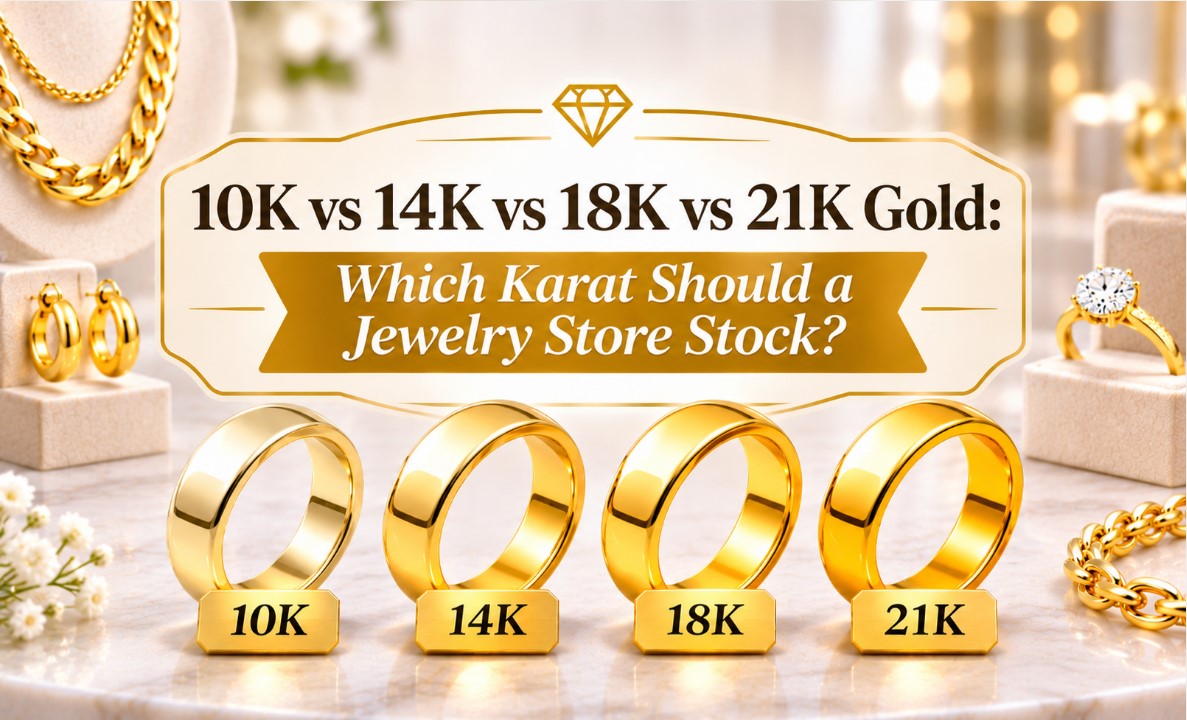
So here is the short version. For most independent stores in the US, 14K is the base of the case. 18K earns a second shelf for gifts, bridal, and finer pieces. 10K is the entry-price and hard-wear option. 21K is a niche karat for customers who already know they want it. The rest of this guide explains why, and how the answer shifts by jewelry type and by kind of store.
The timing matters. The World Gold Council’s third-quarter 2026 report says consumers “generally continued to favour lighter-weight and lower-carat purchases.” Gold itself traded around $3,842 an ounce on November 17, 2026, well below the January peak above $5,100 reported by National Jeweler, and still far higher than two years ago. When metal is that much of the cost, karat stops being a spec on the tag and becomes a pricing decision. Our guide to 2027 gold jewelry trends covers the demand side of that story.
Golden Planet USA is a gold jewelry supplier with production in Turkey and distribution from New York’s Diamond District. It keeps 14K and 18K in stock and makes 10K and 21K to order, which shapes a few recommendations below. The reasoning applies to any supplier, though.
One caution before we start. Most karat guides online are written for shoppers, and many of them copy each other’s numbers. We have kept to what can be sourced or calculated, and where something is an estimate we say so.
10K vs 14K vs 18K vs 21K gold: comparison chart
This is the one-screen version. Everything in it is explained further down.
| Karat | Gold content | Common stamp | Color of yellow gold | Wear | Price position | Best fit | Supply at Golden Planet USA |
| 10K | 41.7% | 417 or 10K | Palest, can read slightly pink | Hard-wearing | Lowest | Entry price, rugged daily pieces | Made to order |
| 14K | 58.3% | 585 or 14K | Balanced, lighter than 18K | Durable, the everyday standard | Mid | Core of most cases: rings, chains, earrings | In stock |
| 18K | 75% | 750 or 18K | Richer, deeper yellow | Softer, shows wear sooner | Upper | Gifts, bridal, finer pieces | In stock |
| 21K | 87.5% | 875 or 21K | Deepest yellow | Softest of the four | Highest | Regional taste, special orders | Made to order |
Two things the chart cannot show. First, price does not rise in step with gold content, because higher karat alloys are also denser and the same design weighs more. We work that out in the arithmetic section. Second, the colors in the chart describe yellow gold. White and rose gold are a different story, and the karat and color section deals with them.
How gold karat works: purity, stamps, and what else is in the alloy
A karat stamp tells you one thing: how much of the piece is gold. It says nothing about the rest of the metal, and the rest matters. It sets the color and the hardness, and it can decide whether a customer with sensitive skin is able to wear the piece at all. Before you compare the four karats, it helps to know what the stamp means and what sits in the alloy next to the gold. Customers ask about both at the counter, and a wholesale spec sheet does not always answer either.
Karat and fineness stamps
Karat measures how many parts out of 24 are gold. 24K is pure gold. 18K is 18 parts gold and 6 parts other metals, which makes it 75%. 14K is 14 out of 24, or 58.3%. 10K is 41.7%, and 21K is 87.5%.
Pieces are stamped either in karats or in fineness, which is parts per thousand: 417, 585, 750, 875. If you buy from Turkey or Europe you will see the numbers more often than the letters. A small trap sits in the 14K stamp. The 585 used in many countries is a rounded standard, while 14 out of 24 is 583.3. Both numbers circulate, and some competitor guides print 58.5% as if it were the real gold content of 14K. The correct figure for the karat itself is 58.3%.
What the other metals do
The rest of the alloy is not filler. It sets the color, the hardness, and in some cases the skin reaction. In yellow gold the extra metals are mostly silver and copper. The Museum of Fine Arts Boston’s conservation wiki, CAMEO, lists a typical 18K yellow alloy as gold with 12.5% silver and 12.5% copper, and a 14K yellow alloy as gold with 30% silver and 11.5% copper. Recipes vary by maker, and other published tables give a different split for 14K. That is a reason to ask your supplier what is in the piece rather than assume.
White gold uses white metals instead: nickel in older and cheaper alloys, palladium in nickel-free ones, usually finished with a rhodium plating. Rose gold leans on copper. Karat tells you how much gold there is. The alloy tells you everything else.
Karat versus carat
Karat with a K is gold purity. Carat with a C is the weight of a gemstone, and one carat is 200 milligrams. The mix-up is common enough that even the World Gold Council spells “lower-carat” the second way when it means purity. When you write a tag or a listing, use K for gold.
The four karats from a retailer’s point of view
A shopper asks which karat is best. A retailer asks which karat will sell, hold up, and still leave a margin once the gold price moves. Those are different questions, and they get different answers. Below, each karat is read the way a buyer has to read it: what it is good for in the case, where it lets you down, and how to bring it in without tying up money.
10K gold: the entry tier
10K is the lowest karat most US retailers sell as solid gold, and it is the cheapest of the four by a wide margin. It is hard, it takes knocks, and it is the karat that opens a price point on pieces that would otherwise be out of reach. That makes it useful for a ring a customer will wear to work with their hands, for men’s pieces, and for the first rung of a price ladder.
The trade-offs are color and customer recognition. A 10K yellow looks paler than a 14K, and because the alloy is more than half other metals, it can drift toward pink. Whiteflash, a retailer, describes 10K as “pale yellow” and as tending to look pinkish because of the copper. Many US customers know 14K and 18K and have never seen 10K.
10K vs. 14K gold is the comparison that matters most when budget is the question. A gram of 14K holds about 40% more gold than a gram of 10K (58.3 against 41.7), and the gap in metal cost is wider once weight is counted, as the arithmetic section shows. We found no public US sell-through data for 10K, so treat it as a test. At Golden Planet USA it is made to order, which fits that approach: sample first, then commit.
14K gold: the everyday standard
14K is the sensible center of most cases, and not because it is fashionable. It holds its shape, its color reads as “gold” to nearly everyone, and it costs noticeably less than 18K at the same size. It suits the pieces that work hardest: a stacking ring, a chain worn every day, hoops, a bracelet that bangs against a desk.
14k vs 18k gold is the argument retailers have most often, and most of it is about wear against color. The International Gem Society says 14K is more resistant to scratches and dings than higher-purity gold, but adds that the difference “is not extreme” and that most people will not notice it. We think that is the fair summary. 14K is the safer default. It is not a different material from 18K, and no customer should be told that 18K is fragile.
18K gold: the premium tier
18K is 75% gold, with a deeper, richer yellow and a better story at the counter. It suits gifts, bridal pieces, and finer designs that are worn less often. Customers who care about what they are buying tend to ask for it by name.
It also weighs more than the same design in 14K, which we put numbers on below, and it is softer. A very fine 18K band marks and bends sooner than a 14K band of the same size, so when you stock 18K, add a little thickness. We cover that in our guide to gold ring band width. For the holiday case, see our note on Valentine’s prep with 18K.
21K gold: the niche tier
21K is 87.5% gold, with the deepest yellow of the four and the softest feel. It is not a mainstream karat in the US, and it should not be sold as a trend. It matters for customers who grew up with it. Kuwait Times reported in June 2025 that jewelers there call 21K “the most sought-after karat among Arabs,” and quoted a jeweler describing it as an ornament that also holds its value. A customer interviewed in the same article said she switched to 21K for better resale value and lower making charges.
21k vs 18k gold is a smaller step than it sounds: 21K holds about 17% more gold than 18K. It is also softer, because the alloy has less room for hardening metals. A reference table from Total Materia lists annealed 18K alloys at 150 and 165 on the Vickers scale, and 21K alloys at 100 and 123. 14k vs 21k gold is the wider gap, since 21K carries about 50% more gold than 14K. For a store whose customers are mostly American shoppers with no regional tie to 21K, it is a special order, not stock. We found no public data on US demand for it, so we will not invent any.
Karat and color: how they connect, and where they don’t
Most guides mash karat and color together. Karat sets how deep a yellow gold looks. The other metals in the alloy set which hue you get at all. Keep those two ideas apart and most confusion goes away.
Karat sets saturation, alloy sets hue
Yellow gold gets richer as the gold share rises. White gold gets its color from white metals and a plating. Rose gold gets it from copper. Karat then adjusts how strongly each color shows. That is why a 21K yellow looks deeper than an 18K, and an 18K deeper than a 14K, and why “karat changes the color” and “karat does not change the color” can both be said by careful people about different metals. A full comparison of white gold vs yellow gold vs rose gold is a separate topic. Here we only follow the karat.
Yellow gold from pale to deep
14k yellow gold vs 18k yellow gold is the easiest color difference to see in person. 14K reads as a balanced, slightly lighter yellow. 18K reads as richer and warmer. Whiteflash calls yellow 14K “slightly less intense” than 18K, and that matches what most people see when two chains lie side by side.
Neither is better. A buyer who likes a soft, modern yellow will prefer 14K. A buyer who wants the classic “gold” look will pick 18K. The practical rule for your case: do not display 14K and 18K yellow pieces together as if they were one color family, because customers will see the mismatch and ask which is “real.”
White gold at each karat
White gold is where karat advice gets muddy, so be careful. Most white gold is finished with a thin rhodium plating, which gives the bright white color. The plating wears, and it needs redoing. Brilliant Earth puts re-plating at $50 to $150 a piece, every one to three years.
The question of 14k or 18k white gold comes down to three things. Durability favors 14K: the International Gem Society says the harder white-metal alloy in 14K resists scratches and dings better. Skin favors 18K, because the higher gold content leaves less room for nickel. And color is disputed. The same International Gem Society article says 18K has a brighter, whiter, shinier appearance, while Whiteflash says plated 14K and 18K white gold “look identical.” Sources disagree about the unplated color, so look at plated and unplated samples side by side before you commit to either.
Rose gold at each karat
18k rose gold vs 14k rose gold is mostly a copper question. More of the alloy is copper in 14K, so it tends to be pinker or redder. 18K has less room for copper and reads as a softer, subtler pink. Whiteflash advises a lower karat for a definite pink, saying 14K is “more likely to achieve” it. Blue Nile says the same thing from the other side: higher karats look softer and more subtle. If your customers want an obvious rose, 14K gives it. If they want something quieter, 18K does. Rose gold copper content also varies by maker, so ask for a sample before you reorder.
Mixing karats in one case
Mixing karats is fine. Mixing them inside one stack or one set is where trouble starts. A customer who buys a 14K yellow band and an 18K yellow band for the same hand will see the color difference. If you sell stacks, sets, or a wedding pair, keep each group in one karat and one color, and say so on the tag.
Durability, scratches, and skin sensitivity: what karat really changes
Customers lean on karat as a shortcut. Higher means better, or higher means softer, or higher means safer for skin. Each of those is partly true and partly a myth. Karat does change how a piece wears, but the alloy and the way the piece was made change it too, and skin reactions follow the metals in the alloy more than the number on the stamp. Here is what the evidence supports, so your staff can answer with facts and not with a slogan.
Why higher karat is softer, and where the alloy changes the story
Pure gold is very soft. Alloying hardens it, and a higher karat means less alloy, so a higher karat is generally softer. That is the whole rule, and it holds up in the numbers. Total Materia’s table lists pure 24K at 20 on the Vickers scale annealed, 21K alloys at 100 and 123, and 18K alloys at 150 and 165.
Two cautions. First, the same karat can be harder or softer depending on the recipe, and the table’s own 18K entries differ. Second, how a piece is made matters as much: the same table shows hardness jumping when metal is worked, with 18K reaching 212 and 227 and 21K reaching 190 and 197. So a worked 21K alloy in the table, at 190, is harder than an annealed 18K one at 150. We did not find reliable published hardness figures for 10K and 14K, and several retailer guides give numbers with no source or method, which is why we are not repeating them.
For the 10k gold vs 18k gold question, the safe version is this: 10K has more alloy in it, so it is generally harder, and 18K generally feels softer under daily wear.
Scratches, bends, and resizing
In a store, hardness shows up as three problems. Scratches appear sooner on softer karats, and they are usually surface marks that a polish removes. Bends happen to thin pieces, and thin 18K bends before thin 14K. AGI Design, a jeweler that publishes a guide on band durability, recommends at least 1.6 mm for durability and 1.8 to 2.0 mm for active wearers, and prefers 14K for everyday wear. Resizing and repairs are a separate conversation with your jeweler, so ask before you promise a customer a resize on a fine band.
Skin sensitivity: it is the alloy, not the karat
Customers ask which karat is “hypoallergenic.” The honest answer is that the reaction comes from the metals in the alloy, not from the karat number. Nickel is the usual cause. Whiteflash calls it “the main culprit” and notes that some 14K alloys are nickel-free. The International Gem Society says the added nickel in 14K white gold can be enough to trigger a reaction and that 18K “shouldn’t cause skin discomfort,” which reflects the lower share of alloy metals. Palladium-based white gold is the common nickel-free choice. Copper can bother some people in rose gold, though Brilliant Earth notes that copper reactions are less common than nickel ones.
So the rule for a store: do not promise that any karat is safe. Ask your supplier what is in the alloy of every white and rose gold style, and train staff to say “this alloy is nickel-free” only when the paperwork says so.
Which karat is best for which jewelry
The matrix at the end of this section is the short answer. The reasoning behind it is below, one type at a time.
Rings
A ring takes the most daily abuse of any jewelry, so it is the strongest case for 14K. 10k gold vs 14k gold vs 18k gold becomes a real choice here: 10K for rugged everyday rings and lower prices, 14K as the standard, and 18K for finer or occasion rings that will not be worn to the gym. Fine stacking bands deserve 14K at 1.8 mm or more. If you must stock them thinner, label them as delicate.
Earrings
Earrings are worn, but they are rarely hit, so karat matters less than weight. 14K suits studs, huggies, and hoops that will be worn daily and slept in. 18K works for dressier pairs and gifts. Earrings are also the best place to take advantage of lower karat for price, because the metal content is small and the entry price matters.
Necklaces, chains, and pendants
A chain flexes with every movement, and kinks and stretched links are the common failures, so in our view a harder alloy generally holds up better. Make 14K the base for a daily chain and for necklaces worn with pendants. 18K suits a fine pendant or a chain bought as a gift. A heavy chain in a high karat is the most price-exposed item in the case. Ask for weights before you order.
Bracelets and bangles
Bracelets are knocked against desks and doors all day. 14K link bracelets are the sensible core. A bangle in 18K will show dents sooner, so offer it as a dressier piece. Weight and price are tied together here more than in any other category, because a bracelet uses more metal.
Stone-set jewelry
Prongs and settings need to hold stones for years. Many jewelers prefer harder alloys for settings, and 14K is a common choice for stone-set rings and pendants. We could not find a standard that sets this, so treat it as practice, and ask your supplier how the settings are made.
Men’s jewelry
Men’s rings and heavy chains see the hardest wear and the highest metal weight. 10K and 14K are the practical choices. A thick chain in 18K or 21K is a large cost for one piece, and it is the one most likely to be compared by weight in a customer’s phone.
| Jewelry type | Main karat | Second | Be careful with | Why |
| Ring | 14K | 18K, 10K | Thin 18K bands | Hard daily wear |
| Earrings | 14K | 18K | Heavy 21K | Light wear, weight drives price |
| Necklaces and chains | 14K | 18K | Heavy chains in high karat | Flexing, and metal cost |
| Bracelets and bangles | 14K | 10K, 18K | Soft 18K bangles | Knocks and dents |
| Stone-set | 14K | 18K | Fine prongs in soft karat | Setting security |
| Men’s | 10K, 14K | 18K | Heavy 21K | Wear and weight |
Which karat is best for wedding and bridal jewelry
Bridal jewelry is the one place where a customer buys for decades and for sentiment at the same time. A ring is worn every day through work, washing, and sleep, and it also has to feel worth the occasion. That pulls the karat decision two ways, toward a harder alloy and toward a richer one, and the right answer depends on the piece. Engagement rings, wedding bands, and matching sets each ask for something a little different.
Engagement rings
An engagement ring is worn every day for decades, which argues for 14K. It is also the most emotional purchase in the case, which argues for 18K. Both are reasonable. A customer comparing 14k gold vs 18k white gold is really choosing between the harder alloy and the higher gold content, with a rhodium finish on either. The Knot’s 2026 Real Weddings Study, reported by National Jeweler, found white gold in 35% of engagement rings, platinum in 13%, and yellow gold in 39%, with yellow’s share more than doubling in five years. It does not report karat. Whichever you stock, the stone setting matters more than the karat.
Wedding bands, women’s and men’s
Wedding bands are worn through manual work, washing, and sleep. A plain band is a place where 14K is hard to beat, and thickness matters as much as karat. For a man’s band, 10K and 14K handle everyday abuse, while 18K and 21K trade durability for richness. Offer a couple of widths and be honest about the trade-offs.
Matching a couple’s set
Couples often want to match. Match karat first, then color. A 14K yellow ring next to an 18K yellow ring will not look the same even though both are “yellow gold,” and a white gold band next to a plated one will not either. If you sell pairs, stock them in the same karat and say so.
Resizing and engraving
Bridal buyers resize and engrave. Ask your jeweler how each karat you stock behaves, and avoid selling fine, thin bands to customers who may need to resize them more than once.
Bridal sets and gifts
For bridal party gifts and anniversary pieces, 18K carries the stronger story, and 14K carries the better price. Keep both in the case and let the customer choose.
What each karat costs: the arithmetic
Price is where karat advice usually goes vague. Guides say 18K costs more than 14K and stop there. For a retailer the useful question is how much more, and the answer has two parts: how much gold is in the piece, and how much the piece weighs. The numbers below use one spot price and one design, so you can follow every step and rerun it with your own weights.
Pure gold content and the karat premium
The simplest calculation is the metal in a gram of finished jewelry. At a spot price of $3,841.58 an ounce (November 17, 2026, as quoted by USAGOLD), pure gold is about $123.51 a gram. Multiply by the gold share and you get this. It covers metal only, with no labor, finish, stones, or margin.
| Karat | Gold share | Metal value per gram of finished jewelry |
| 10K | 41.7% | about $51.50 |
| 14K | 58.3% | about $72.00 |
| 18K | 75% | about $92.60 |
| 21K | 87.5% | about $108.10 |
Refresh the spot price before you use these numbers. It moved 3% in a single session on November 12, and the table is only as current as that date.
Same design, different weight
Here is the part most guides skip. A customer does not buy a gram. They buy a design, and a given design is the same size in every karat. Because gold is denser than silver and copper, a higher karat alloy packs more weight into the same volume. So the real cost gap is wider than the purity gap.
We estimated densities from typical yellow-gold recipes: about 11.8 g/cm3 for 10K, 13.9 for 14K, 15.5 for 18K, and 17.1 for 21K. The 18K figure matches the 15.45 that CAMEO lists for a 12.5% silver, 12.5% copper alloy. The other three are our calculation, and real alloys vary, so treat the results as estimates and ask your supplier for actual weights. Using a 10 gram 14K chain as the baseline, the same design works out like this.
| Karat | Estimated weight | Gold in the piece | Metal value at $123.51 a gram |
| 10K | about 8.5 g | about 3.5 g | about $436 |
| 14K | 10 g | 5.8 g | about $720 |
| 18K | about 11.1 g | about 8.3 g | about $1,027 |
| 21K | about 12.3 g | about 10.7 g | about $1,325 |
The ratios are what matter. The same chain in 18K holds about 1.43 times the metal value of the 14K one, not the 1.29 that the purity ratio suggests. 21K holds about 1.84 times the metal value of 14K. And 10k vs 18k gold is the widest gap in the everyday range: the 18K version carries roughly 2.35 times the metal value of the 10K version of the same design, while the purity ratio alone says 1.8.
Margin and price ladder
Do not mark every karat up by the same multiplier. A heavy 18K chain with a 2x markup will land at a shelf price that looks like a large multiple of its gold, and customers can look that up on their phones. Use the margin formula instead: retail price = cost / (1 – target margin). A 50% margin means multiplying cost by 2.0, 45% means 1.82, and 40% means 1.67. Heavy, metal-led pieces generally need a lower multiplier than light, design-led pieces. Our guide to how retailers set retail prices from wholesale goes through the method.
A useful ladder: 10K and 14K at the entry and middle rungs, 18K at the top of each category, and 21K only as a special order priced at replacement cost.
Gold price swings and your karat mix
Gold fell from above $5,100 in January 2026 to $3,842 in mid-November, a drop of roughly a quarter. A fall like that helps buyers of 21K and 18K the most in dollar terms, because those karats hold the most gold. A rise hurts them the most. If you hold a lot of high-karat stock, you carry more of the price risk in each piece. If you hold more 14K and 10K, you carry less. That is a reason to match your karat mix to how fast each karat sells, not only to what looks best in the case.
How to choose your karat mix by store type
There is no universal ratio, and any number we gave you would be a guess. What follows is the reasoning for the common store types. Start from last year’s sales by karat, then adjust.
Independent bridal and fine jeweler
Bridal customers want durability and a story, so 14K and 18K both earn space. 14K covers wedding bands and everyday rings. 18K covers engagement settings, gifts, and the finer end of the case. 10K has little role here, and 21K is a special order only.
Everyday and gift jewelry store
Volume and price points matter most. Make 14K the core, add 10K where you need a lower price rung, and keep a smaller layer of 18K for gifts and holidays. Earrings, thin chains, and small pendants are where this store wins.
Boutique and fashion store
Design and look lead, and weight is the enemy. Use 14K for most pieces, a little 10K for price, and 18K for a few signature items. Choose lighter builds, since the World Gold Council reports customers shifting toward lighter weights and lower karat.
Community and regional-market store
If your customers come from the Gulf, Egypt, or other places where 21K is the habit, it may deserve more room than it would anywhere else. Kuwait Times describes 21K as the karat jewelers there say Arabs seek most. Ask your customers, listen to what they request, and place small made-to-order batches before you stock it.
Stock versus made to order
Stock what turns fast and order what turns slowly. At Golden Planet USA, 14K and 18K are held in stock, and 10K and 21K are made to order. That split is practical, not a verdict on the karats: it keeps the fast sellers on the shelf and lets you try the others without tying up money. Ask any supplier for minimum quantities and lead times on made-to-order karats before you plan a season.
A simple way to test before you commit
Order a small batch of the karat you are unsure about, in two or three styles. Decide before the test what a win looks like: how many units, over how many weeks. Put the pieces in the case beside your core, and review. A sample order is the cheapest way to check weight, finish, and stamps, and our guide to jewelry sample orders lists what to inspect.
How to verify karat before you buy wholesale
A karat stamp is a claim. Check it before you pay for a full order.
First, look at the stamp itself. In the US, a karat quality mark should come with the maker’s trademark or name. The FTC’s Jewelry Guides (16 CFR Part 23), in a note to section 23.10, say that under the National Gold and Silver Stamping Act a manufacturer or dealer who applies a quality mark must also apply its trademark or name. The Guides also say karat markings are subject to the Stamping Act tolerances: three parts per thousand for gold with no solder, and seven parts per thousand where solder is used, as we read the footnote. That is why a piece stamped 14K can legitimately assay a few tenths of a percent below 58.3%.
Second, ask the supplier for documentation: the alloy used, whether the white gold is nickel-free, whether pieces are plated, and the actual weight of each style. Third, test the sample. A local jeweler or assay lab can check composition with X-ray fluorescence, which reads the alloy without damaging the piece. Fourth, weigh and measure it against the spec, as we described in the sample orders guide.
This is general information, not legal advice, and marking rules change. Check the current text of the FTC Guides or ask counsel before you print karat claims on tags and listings.
Final thoughts
Choosing a karat is mostly arithmetic and honesty. Do the arithmetic: the same design in 18K carries around 40% more metal than in 14K, and in 21K around 80% more. Be honest about wear: nothing here says one karat is better, only that each is better at something. Start with 14K as your base, give 18K the shelf where occasion and gifts live, test 10K and 21K in small made-to-order batches, and write down what a good result looks like before you begin.
This week, pull your last twelve months of sales by karat and by category, and see where the money actually came from. When you are ready to compare samples, ask Golden Planet USA about its wholesale gold jewelry.
FAQ
- Which karat should a jewelry store stock?
For most US stores, 14K as the core, with 18K for gifts, bridal, and finer pieces. Test 10K and 21K as made-to-order options until you have your own sales data.
- Is 14K or 18K better for a jewelry store to sell?
Neither on its own. 14K is the safer everyday seller because it is harder and costs less. 18K has a richer color and a stronger gift story. Most stores need both.
- What is the difference between 18K and 21K gold?
21K is 87.5% gold and 18K is 75%, so 21K holds about 17% more gold, has a deeper yellow, and is softer. It is mainly bought in the Gulf and Egypt, so for most US stores it is a special order.
- Is 10K real gold?
Yes. 10K is 41.7% gold, with the rest other metals, and it can be sold as 10K gold when it is stamped honestly. It is paler and harder than higher karats.
- Which karat is best for wedding bands?
14K is the usual choice for everyday wear. 18K suits those who want richer color and accept a softer metal. Thickness matters as much as karat.
- Which karat is best for sensitive skin?
No karat is safe by default. Reactions come from alloy metals, usually nickel. Higher karat has fewer alloy metals, but a nickel-free 14K exists. Ask for the alloy.
- Is 21K gold sold in the United States?
Yes, though it is less common on US shelves than 14K and 18K, so most retailers offer it as a made-to-order line for customers who ask for it. Demand follows communities where 21K is the habit: jewelers in Kuwait call it the karat Arabs seek most. At Golden Planet USA, 21K is made to order, so you can offer it without holding inventory.
- How can a retailer verify the karat of wholesale jewelry?
Check the stamp and the maker’s mark, ask for alloy and weight documents, test samples with X-ray fluorescence at a local jeweler or assay lab, and keep a reference sample.