
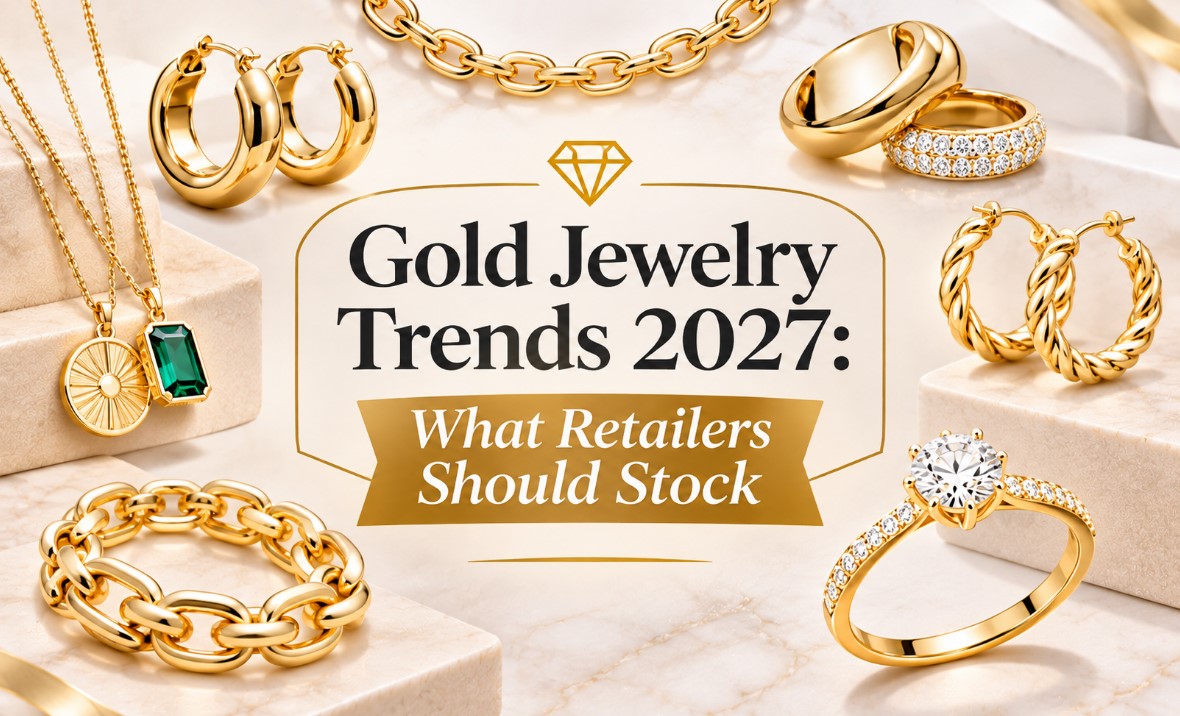
Most gold jewelry trends articles tell you what customers will wear. This one is about what to put in your case and how much of it, at a time when gold costs far more than it did two years ago and everyone who walks in knows it.
The short version: people are buying less gold by weight and spending as much or more in dollars. The World Gold Council counted 313 tonnes of jewelry demand worldwide in the third quarter of 2026, down 17% from a year earlier and the weakest third quarter in its data, which starts in 2000. The value of that demand still rose 2%, to $43 billion. Fewer grams, more dollars. That one fact shapes almost every call below, from karat to chain width to which earrings earn a second row on the shelf.
The advice applies to any supplier, including Golden Planet USA, a manufacturer of gold jewelry with production in Turkey and distribution from New York’s Diamond District. Trending gold jewelry is only worth stocking if it sells through at a margin you can live with, so every category section ends with a plain call: buy it, test it small, or leave it.
A note on sources. The trend picture here comes from trade reporting, retailer guides, and the couture shows, and we name each one so you can judge it. Retailer blogs sell what they stock. Designers at a couture show are not your customers. Where the data is thin, as it is for men’s jewelry, we say so.
The gold jewelry market going into 2027
Fewer grams, more dollars
The third quarter was not a blip. According to the World Gold Council, jewelry demand fell year on year for the 13th quarter in a row. The first nine months of 2026 came in at 889 tonnes, down 19% and the lowest nine-month total in the series, while the value of that demand rose 15% to almost $130 billion. The report’s own summary is short: “High prices remained the key constraint on demand in Q3.”
The US is a smaller copy of the same picture. American jewelry demand was 21 tonnes in the quarter, down 18%, and its value, about $3 billion, was roughly flat. Across regions, the council says consumers “generally continued to favour lighter-weight and lower-carat purchases.”
US retail data tells a similar story in dollars. Tenoris, which tracks American jewelry sales, reported that sales rose 8.6% in the first half of 2026 while the average purchase price rose 19%. Price did most of the work. Writing in National Jeweler, retail consultant Sherry Smith put it this way: some of retailers’ higher average sales are “mathematical, not behavioral.” She also noted that unit sales below $1,500 kept declining. That figure covers all jewelry, diamonds included, so read it as a warning about the mid-price shelf rather than a verdict on gold.
Where gold prices stand
Gold went past $5,100 an ounce in January 2026, slid to about $4,600 by late March, and ended August at $4,563. On November 12 it fell 3% in a single session to $3,868, its lowest level since October 2025, as rate-hike expectations and a stronger dollar weighed on it, according to Reuters. That is roughly a quarter below the January peak.
Cheaper gold sounds like good news for demand, and it may be. But tags set during the spike do not all come down with the metal, and a price that can move 3% in a day is a poor thing to build a forecast on. Plan for volatility, not for a direction.
How customers are adapting
Buyers are not leaving gold. They are changing how they buy it. Pieces get lighter, with thin chains, hollow forms, and narrower bands. Karat drops, from 18K toward 14K and 10K. And more of the value moves into stones and design, which is why colored gemstones, lab-grown diamonds, and pearls keep showing up in trend reports. Tenoris called pearl jewelry “surprisingly strong” in the first half of 2026.
The World Gold Council saw the same behavior in other markets. Indian buyers reduced the fine gold content of what they bought, and lightweight designs stayed popular in China.
What this means for your 2027 buying plan
Start with weight, not style. For every category you carry, decide the weight range you are comfortable buying and what retail price it produces, then look for designs that fit inside it. A trending piece that only works at 12 grams is a risk. The same trend in a hollow or narrower build might be a good buy.
Keep heavy pieces few and keep them moving. Test new styles in small quantities. And buy with the assumption that your replacement cost will change before the piece sells, because it probably will.
Gold color trends for 2027
Fashion trends in gold jewelry tend to move faster than the metal itself. Colors come and go in design reports, but what hangs on your shelves is mostly a bet on three of them.
Yellow gold stays the anchor
Yellow gold has the strongest evidence behind it, and it comes from weddings, where metal choices are tracked. The Knot’s 2026 Real Weddings Study, reported by National Jeweler, found that white gold made up 35% of engagement rings, platinum 13%, and yellow gold 39%. Yellow gold’s share has more than doubled in five years. That is a bridal figure, not a fashion one, but a shift that large rarely stays inside bridal.
Retailers are reading it the same way. Brilliant Earth’s 2027 trend guide, updated in November, builds its “bold gold” section around polished yellow gold: thick huggie hoops, omega chains, herringbone necklaces. Gabriel & Co. describes a yellow gold comeback in bold cuffs, chain necklaces, and vintage-inspired rings. Both are retailers selling what they make, so take the language with some salt, but they agree with the wedding data.
Rose gold and white gold: where they still earn space
Rose gold shows up in the couture shows rather than in sales data. Who What Wear’s report from the June 2026 couture week in Las Vegas mentions 18K rose gold in dome rings and lariat necklaces. We found no consumer sales figure for rose gold, so we would treat it as a test line: a few styles, small quantities, a fixed review date.
White gold is not fading. It is changing jobs. It still leads bridal, and in fashion it is being used as a cool contrast against warmer tones, in cuffs, ear stacks, and two-tone pieces. A full comparison of white gold vs yellow gold vs rose gold deserves its own guide, so here we only cover what changes the buy.
Two-tone and mixed gold
Mixing tones is the least risky way to add color variety. Jewelers Mutual’s 2026 forecast lists mixed metals and modern stacking among its main trends, with yellow, white, and rose combined within a piece or across a stack. For you, that means two-tone pieces and a few matching-weight singles in different colors that customers can layer.
Finishes: polished, brushed, textured
Polished still reads as “gold” to most buyers and photographs well, which matters online. Jewelers Mutual also pairs sapphires with brushed yellow gold, and sculptural, twisted shapes are common in Gabriel’s list. A little texture is useful for stacking, because it separates one band from the next. Do not let finish multiply your SKU count: pick one or two finishes per category and keep the rest simple.
Karat in 2027: 10K, 14K, 18K, and 21K
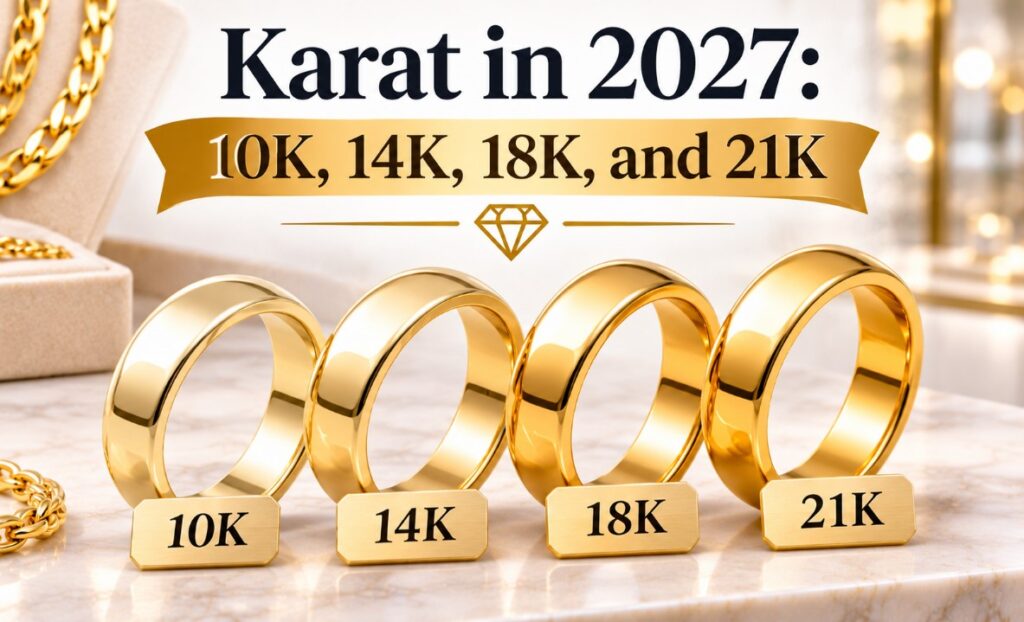
Karat decides how much gold is in a piece, and in 2027 it matters more than it used to because metal is the largest share of cost on most pieces. The percentages are fixed by definition. The rest depends on how a piece is worn.
| Karat | Gold content | Look | Where it fits |
| 10K | 41.7% | Paler, hardest of the four | Entry price, made to order |
| 14K | 58.3% | Balanced color, durable | Everyday core: chains, hoops, stacking bands |
| 18K | 75% | Richer, deeper yellow, softer | Gifts, bridal, occasion pieces |
| 21K | 87.5% | Deepest color, softest | Regional taste, made to order |
Where 14K leads
14K is the default for a reason. It holds its shape, costs noticeably less than 18K at the same weight, and looks like gold to nearly everyone. It is the sensible karat for thin bands, hoops, and chains that get worn daily. AGI Design, a jeweler that publishes a guide on band durability, prefers 14K for everyday wear and describes 18K as richer in color with a slightly softer feel.
Where 18K earns its place
18K is the gift karat. The color is deeper, the name carries weight with customers, and it suits pieces that are worn less often or bought for an occasion. We cover the holiday case in a separate guide on Valentine’s prep with 18K gold. Keep 18K pieces a little heavier than you would in 14K, because a very fine 18K band marks and bends sooner.
Where 10K and 21K fit
The two outer karats are specialist buys. 10K lowers the metal cost most, which fits the lower-carat shift the World Gold Council describes, but we have found no public US sell-through data for it, so the honest advice is to test. 21K is traditionally preferred in parts of the Middle East and North Africa and is uncommon elsewhere. At Golden Planet USA, 14K and 18K are held in stock and 10K and 21K are made to order, which is a sensible way to carry them: ask for a sample, sell from the sample, then order.
A deeper look at 10K vs 14K vs 18K vs 21K gold belongs in its own guide. Here is the part that matters for trends.
How to split your karat mix
There is no universal ratio, and any number we gave you would be a guess. A workable method is to start from last year’s sales by karat, move a little weight from 18K toward 14K in everyday categories, and keep 18K where customers buy for the occasion. Remember that higher karat alloys are denser, so the same design weighs more in 18K than in 14K, and the metal cost climbs with it.
Gold rings: trends and what to stock
Rings are where trends are easiest to spot and hardest to buy well, because size runs multiply every style by a dozen. Be pickier here than anywhere else in the case.
What is moving in rings
Trending gold rings in 2027 fall into a few families, and most of them are quieter than last year’s cocktail rings.
Signet and pinky rings are the clearest one. Marie Claire’s January 2026 trend report names pinky rings, both signets and tiny gemstone rings, worn alone or stacked. Gabriel & Co. adds a “stirrup” motif, a slim ring shaped like a stirrup link that sits next to a plain band. Bezel settings, where a smooth metal rim frames the stone, appear in both Brilliant Earth’s 2027 guide and Gabriel’s list. Dome rings in 14K yellow gold came up at the June couture shows. Jewelers Mutual’s forecast mentions winding gold bands, a twisting, organic shape.
If you want a short list of trending gold ring designs to look at first, it is this: a smooth signet, a slim stirrup or link band, a bezel-set ring with a small stone, a dome, and a twisted band. Plain stackable bands under all of them.
Thin bands and stacking
Stacking keeps the thin band selling. A customer who buys one fine ring often comes back for two more. But thin has limits. AGI Design recommends a minimum width of 1.6 mm for durability, and 1.8 to 2.0 mm for people with active, hands-on lives. Another jeweler, Ethan Lord, says anything under 1.5 mm may be more prone to bending. These are retailer rules of thumb, not standards. We cover how to measure them in our guide to gold ring band width and durability.
The practical point: if you stock very fine bands, sell them as delicate and tell customers to take them off for the gym. If you want a thin ring that will survive daily wear, 14K at 1.8 mm or more is the safer recommendation.
Fashion rings and fine bands
At Golden Planet USA, about 90% of the rings sold are women’s. The useful split for female customers is between fashion rings, where color and shape lead and price is secondary, and fine stacking bands, where width and finish decide. Make sure your ring display shows both, because they are bought in different moods. The gold rings range includes both kinds.
The call for rings
Stock: smooth stacking bands in 14K yellow gold in a full size run, plus a signet or two. These sell steadily, and a size run built once can be topped up cheaply.
Test: domes, bezel-set rings with small stones, and twisted bands, in a handful of styles and in a few sizes. Add one rose gold style if you want a color test.
Leave for now: bands under about 1.5 mm in 18K without a clear “delicate” label, and heavy statement rings whose price depends on weight. At today’s metal costs, a 10 gram ring is a large bet on one customer.
Gold bracelets: trends and what to stock
Bracelets were the strongest category in the first half of 2026. According to Tenoris, they had the highest revenue of any jewelry category and grew 14% against the first half of 2025, with average spend per item up by double digits. The category includes diamond tennis bracelets, so this is not a gold-only figure. It still tells you that customers are willing to spend on a wrist.
What is moving in bracelets
Trending gold bracelets in 2027 are built for stacking and for contrast. Gabriel & Co. suggests alternating chunky links with slimmer ones on the same wrist, or wearing one bangle or link bracelet alone. Jewelers Mutual’s forecast notes chunky cuffs that pair with oversized tailoring, and Marie Claire’s list of “bold metallics” includes cuffs. Brilliant Earth’s 2027 guide features bezel-set tennis bracelets, though those lean on stones more than on gold.
The common thread is visible gold. A customer buying a bracelet in 2027 wants it to look like gold from across a table.
The weight problem
Bracelets are also where the metal bill hurts first. A bracelet takes more grams than an earring or a pendant, so a rise in gold moves its price the most. That makes build important. Hollow links, thinner wire, and lighter cuffs let a design look substantial at a lower weight. Gabriel & Co. lists a hollow 14K bracelet among its men’s styles, so the construction is clearly in use. Ask your supplier for the weight of every bracelet and compare it with the look you are paying for.
Length matters too, and it is cheap to fix. Offer two lengths on link bracelets so one style covers more wrists, and say the length on the tag.
The call for bracelets
Stock: 14K link and chain bracelets at moderate weights, in at least two lengths.
Test: a cuff or a bangle in polished yellow gold, and one two-tone stack of matching links.
Leave for now: heavy solid cuffs unless you have a specific customer waiting for one.
Gold earrings: trends and what to stock
Earrings are the opposite of bracelets in the numbers. Tenoris put pendants and earrings among the slowest-growing categories in the first half of 2026. That does not make them a bad category. It makes them an entry-price one, bought as an add-on or a gift, and the right place to keep your lower price points full.
What is moving in earrings
Trending gold earrings in 2027 come in two sizes. Thin gold hoops are the everyday item. Gabriel & Co. calls them “reinvented hoops,” and says they sit beside oversized, 90s-inspired chunky tubes with a slight curve. Brilliant Earth’s 2027 guide features thick huggie hoops in yellow gold under its “bold gold” heading.
Ear stacking is the other pattern. Gabriel suggests two to four pieces on one ear, with a larger piece anchoring the lobe, and Jewelers Mutual’s forecast describes mismatched huggies, cuffs, and studs. For you, that turns one sale into three: a stud, a huggie, and a cuff, sold together.
New trending gold earrings to test
Several newer earring shapes are worth a small trial. Asymmetric pairs, where each ear gets a different piece from the same family, are one. A single ear cuff, often in white gold, with a simple stud on the other ear is another. Statement studs, bold enough to replace dangles, are a third. Sculptural, elongated shapes that catch light from different angles also appear in Gabriel’s list.
None of these have sales data behind them. They come from retailer guides and design forecasts, so treat them as ideas to put in front of customers, not as proven sellers.
The call for earrings
Stock: 14K studs and huggies in simple shapes, plus a set of small hoops in two sizes. These are the easiest earrings to restock and the easiest to sell in multiples.
Test: chunky hoops (check the weight carefully), ear cuffs, and one asymmetric pair.
Leave for now: large gold dangles. They are heavy for the visual impact, and the trend lists are moving toward studs and stacks instead.
Gold necklaces and chains: trends and what to stock
Necklaces are the category with the most obvious trend language and the least hard data. Tenoris did not give a necklace figure for the first half of 2026, so what follows comes from design guides and trade shows.
What is moving in necklaces
New trends in gold necklace design fall into a few directions that overlap. The first is bold chain. Brilliant Earth’s 2027 guide features omega chains and herringbone necklaces in polished yellow gold. Gabriel & Co. describes a mid-length chain worn alone and a single oversized link used as a pendant. The second is the lariat: Who What Wear’s report from the June couture week names long lariat necklaces, including convertible designs, as the likely replacement for last summer’s tassel necklace, which it says is slowing down. The third is sentimental jewelry. Brilliant Earth lists zodiac medallions, script name necklaces, and engravable lockets.
Chain styles in demand
Chain style is where trending gold necklaces get decided at the case. Cuban, rope, Franco, herringbone, box, Figaro, and paperclip appear on most retailer lists. The paperclip is the one Jewelers Mutual mentions by name in its forecast. Chain style matters less than weight and width, though. A chain’s price is mostly its metal, and customers compare weight across stores more easily than they compare design.
A simple approach is to pick two or three chain styles and carry each in two widths, one thin and one bolder, rather than carrying eight styles in one. A thin chain is the entry sale. A heavier one is the statement piece, and the one most exposed to gold’s price.
Pendants and personalization
Personal pieces hold up in a market where customers are buying less. A medallion, an initial, or a birthstone pendant on a simple chain is a gift with a reason, and it can be engraved or customized in your store without ordering anything new. Gabriel’s women’s list also points to birthstone-colored pendants.
Layering and lengths
Layering is the habit that sells chains in pairs. Gabriel suggests a fine choker layered with shorter pieces. A typical set uses lengths a couple of inches apart, for example 16, 18, and 20 inches, so each chain sits clear of the next. Stock the same style in two or three lengths and say so on the tag.
The call for necklaces and chains
Stock: thin and mid-width chains in 14K in two or three lengths, plus a few simple pendants.
Test: an oversized link pendant, a lariat, and a medallion or an engravable locket.
Leave for now: tassel necklaces, which Who What Wear says are slowing down, and any chain whose weight you have not checked against its price.
Stones in gold: colored gemstones, lab-grown diamonds, and CZ
When gold gets expensive, stones do the work that grams used to do. A small gold piece with a good stone can look finished and feel like a gift, and it carries less metal than a plain heavy one. That is a big reason color has taken over the trend reports.
Who What Wear’s June 2026 couture report called color “the biggest takeaway,” and its author noted designers moving away from gold because of its price, with 9K and 18K rose gold pieces among the examples. That is the top end of the market, but the logic travels down. Brilliant Earth’s 2027 guide leans on green, with its merchandising lead Annie Chen describing green as working “like a neutral.” Peridot, smoky topaz, blue topaz, and emerald are the stones it names. Yellow gold warms green stones, which is part of why the pairing keeps appearing.
Lab-grown diamonds now make up most bridal center stones. The Knot’s 2026 Real Weddings Study found they made up 61% of engagement ring center stones bought in 2025. In the first half of 2026, Tenoris reported double-digit revenue growth for lab-grown jewelry with flat average spend, so the growth came from more units, not bigger tickets. Wholesale lab-grown prices fell 14% in the first quarter of 2026, according to Tenoris data cited by Sherry Smith. That is good for a retailer’s margin and bad for anyone who assumed the price would hold.
Cubic zirconia is a different conversation. We found no public trend data on CZ demand, and we would not call it a trend at all. It is a price tool: a way to put a sparkling look at a low entry price in 10K or 14K. If you use it, label it plainly, and keep it away from the pieces you describe as fine jewelry.
What to do with all this: add a small number of stone-set gold pieces in colors that read as neutral, such as green, blue, and yellow stones, in simple bezel or prong settings. Check the setting first, because loose stones are the return you want least. Ask the supplier for the stone type and whether it is natural, lab-grown, or CZ, and put that on the tag.
Men’s gold jewelry trends for 2027
The honest summary: the styles are clear, the numbers are not. Market-size claims for men’s jewelry circulate on retailer sites, but the ones we found had no primary source, so we are leaving them out. What we do have is a consistent picture from two retailers.
Chains lead. Gabriel & Co.’s men’s guide names thick Cuban links, Figaro, oval link, and rope chains in gold or silver, and Robinson’s Jewelers, in a March 2026 post, calls thicker chains the main trend with the Cuban “leading the charge.” Signet rings are the second pattern: both describe a comeback, with family crests, initials, or plain stone faces. Pendants with personal meaning come next, such as initials, zodiac symbols, and medallions. Beaded bracelets with metal spacers and mixed metals round out the list.
Two notes for a gold supplier. Chains for men are heavy by nature, so they carry the most price risk of any men’s item. Narrower widths and hollow constructions bring the cost down without changing the look much. And men’s earrings: none of the sources we read gave them real coverage, so we would not buy them on a trend basis.
If most of your rings are women’s, as at many shops, men’s is an addition, not a rebuild. A starter group for men is small: one Cuban chain in two widths, one Figaro or rope chain, a plain signet, and a link bracelet. Put them together in one case so they read as a collection, and look at sell-through after one season.
How to build your 2027 assortment: core, test, and skip
Put the categories together and you get a simple three-part plan. The method matters more than the exact split: a rule of thumb we would start from is about 70% core, 20% test, and 10% held back for what turns up mid-year. That is our rule of thumb, not an industry statistic, so replace it with your own sell-through data as soon as you have it.
| Category | Core | Test | Leave for now |
| Rings | Smooth stacking bands, 14K yellow, full size run; a signet | Domes, bezel-set, twisted bands; one rose gold style | Bands under 1.5 mm in 18K without a “delicate” label; heavy statement rings |
| Bracelets | 14K link and chain bracelets, two lengths | Polished cuff or bangle; two-tone stack | Heavy solid cuffs |
| Earrings | Studs, huggies, small hoops in 14K | Chunky hoops, ear cuffs, asymmetric pair | Large gold dangles |
| Necklaces | Thin and mid-width chains in two or three lengths; simple pendants | Oversized link pendant, lariat, medallion, locket | Tassel necklaces; unchecked heavy chains |
| For men | A Cuban chain in two widths, plain signet | Figaro or rope chain, link bracelet | Earrings, until there is data |
Balancing price tiers
Keep a clear entry tier, a middle tier, and a small top tier. Tenoris reported that unit sales below $1,500 continued to fall across all jewelry, which suggests the lower-middle shelf is under pressure, so do not fill it with lookalike pieces. Earrings and thin chains are your natural entry tier. Mid-weight chains and bracelets make up the middle. A few heavier or stone-set pieces anchor the top and give the rest of the case context.
Stock versus made to order
Hold your core in stock. Let the test group come from small orders, and use made to order for the karats and sizes that do not turn fast. At Golden Planet USA, 14K and 18K are held in stock and 10K and 21K are made to order. If you are new to a supplier, a sample order is the cheapest way to check weight, finish, and clasp quality. We explain what to inspect in our guide to jewelry sample orders.
Before any test begins, write down what a win looks like: how many units, over how many weeks. Otherwise every test ends with “it did okay” and gets repeated for another season.
A 2027 buying calendar for gold jewelry
Work backward from the date customers will hold the piece. Lead times vary by supplier and by item, so ask for yours and add a buffer, especially on made-to-order karats. Beyond that, the calendar looks like this.
| Window | Date to plan for | What to decide |
| Valentine’s Day | Sunday, February 14, 2027 | Gift pieces in 14K and 18K: pendants, studs, thin chains, stacking rings |
| Mother’s Day | Sunday, May 9, 2027 | Pendants, birthstone pieces, bracelets, earrings in sets |
| Wedding season | Spring through fall | Bands, stacking rings, gifts for bridal parties |
| Fall and holiday | Thanksgiving is November 25, 2027 | Heavier statement pieces, men’s chains, gift sets |
Tenoris found that Valentine’s Day and Mother’s Day were the strongest sales periods of the first half of 2026, so those two are where most stores should place their biggest orders. We would settle Valentine’s stock before Thanksgiving this year, so pieces arrive in time to be photographed and listed. If you need help with the photos, see our guide on photographing gold jewelry without a studio.
Build each window as a small order, reviewed after it ends. Gold’s price changes faster than a season, so a large order placed far ahead carries more price risk than three smaller ones placed closer to the date.
Pricing trend pieces without leaving margin on the table
A trend piece usually has a design premium, and your pricing should reflect it. But the premium works differently depending on weight. Light, design-led pieces like fine earrings or small pendants can carry a higher multiplier, because customers compare design, not grams. Heavy chains and bracelets are compared by weight across stores, so the room above metal cost is smaller.
Use the margin formula, not a flat doubling: retail price = cost / (1 – target margin). A 50% margin means a 2.0 multiplier, but a 45% margin is 1.82, and a 55% margin is 2.22. Then check how much of the cost is metal. At about $3,870 an ounce, pure gold is roughly $124 a gram, and a 5 gram 14K chain holds about $361 of it (5 × 0.583 × 124). Metal is most of that chain’s cost, so a keystone price on it will look high to anyone who checks.
Price on replacement cost, set a review date, and reprice downward when gold falls, too. Customers remember who passed on a lower price. For the full method, read our guide on how retailers set retail prices from wholesale.
Final Thoughts
Gold jewelry in 2027 rewards stores that buy by weight, test in small batches, and keep a simple core. The styles are not hard to find: signets, bezels, huggies, bold chains, a few colored stones. The hard part is buying them at weights and karats your customers will pay for.
Start this week with one number: your last twelve months of sales by category and karat. Choose three test pieces, write down what a win looks like, and order them in a small quantity. When you are ready to put samples in front of customers, ask Golden Planet USA about its wholesale gold jewelry.
FAQ
- What are the latest trends in gold jewelry?
Bold yellow gold chains and hoops, signet and pinky rings, bezel settings, stacking bands, ear stacks, and colored stones set in gold. Mixed metals are also widely listed. Most of this comes from retailer guides and design forecasts, so test before committing.
- Is yellow gold still in style?
Yes. Yellow gold made up 39% of engagement rings in The Knot’s 2026 Real Weddings Study, and its share has more than doubled in five years. Retailers such as Brilliant Earth and Gabriel & Co. also lead their 2026 and 2027 guides with polished yellow gold.
- Is rose gold still popular?
It is shown at couture level, but we found no consumer sales data for it. Treat it as a test line: a few styles, small quantities, and a review date.
- Which gold karat should a jewelry store stock?
For most stores, 14K as the everyday core and 18K for gifts and occasion pieces. 10K and 21K work better as made-to-order options until you have sell-through data of your own.
- Will high gold prices hurt jewelry sales in 2027?
They already reduced volume. Worldwide jewelry demand fell 19% by weight in the first nine months of 2026, while its value rose 15%. Nobody can say what happens in 2027, but the pattern so far favors lighter, lower-karat, and stone-set pieces.
- Are men’s gold chains still in demand?
Retailers describe thick Cuban, Figaro, and rope chains as the main men’s trend. There is no reliable independent sales data, so start small and check sell-through after a season.
- Is 14K or 18K better for everyday wear?
14K. It is harder and holds its shape better, especially in thin bands and chains. 18K has richer color and suits pieces worn less often.
- How much of the case should be new trend pieces?
Start with roughly 20% for tests and 10% in reserve, and adjust once you see which tests sell. That split is a rule of thumb, not a statistic.