
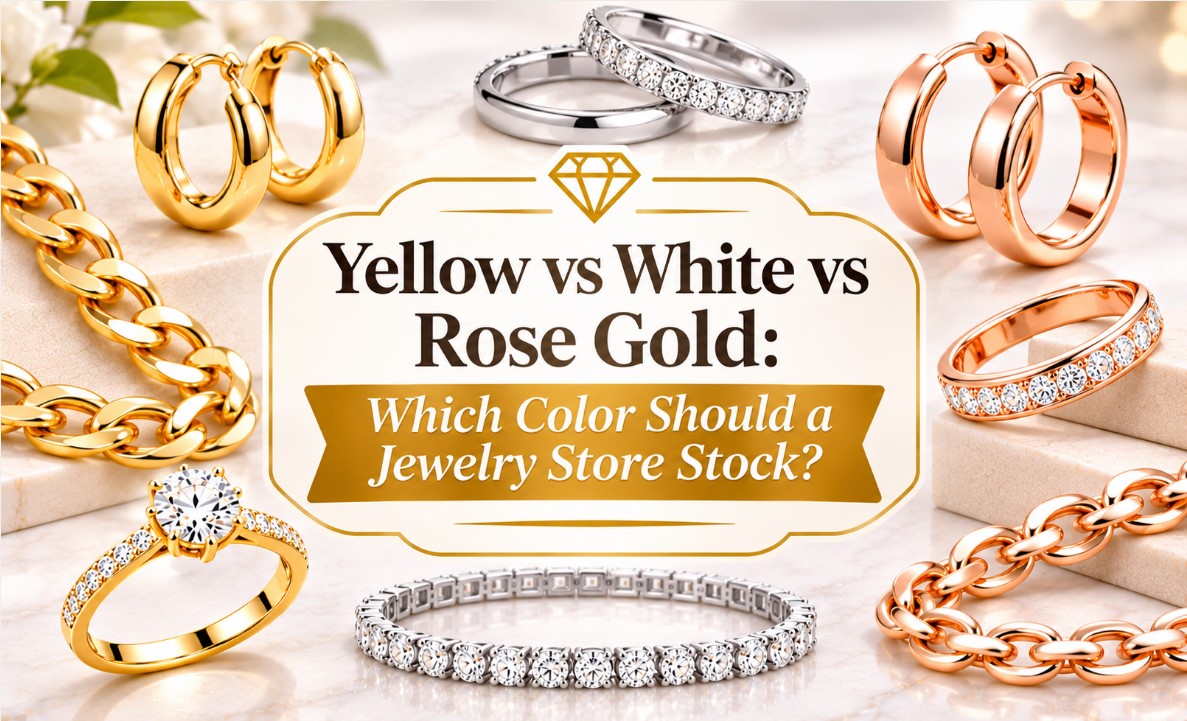
Most guides help a shopper choose between white gold or yellow gold for a single ring. A retailer has a harder job. You have to decide how much of each color to buy, for every category in the case, with a limited budget and gold prices that move by the day.
Here is the short answer. Yellow gold is the base of most cases, and its position is getting stronger. White gold earns a solid second place because bridal and diamond jewelry still lean on it. Rose gold is a smaller line worth testing before you commit. The rest of this guide shows where those calls come from, with data where it exists and plain reasoning where it does not.
The advice applies to any supplier, including Golden Planet USA, which sells direct factory jewelry made in Turkey and distributed from New York’s Diamond District. Check with whichever supplier you use which colors and alloys it makes, because that decides what you can stock.
A word on sources. Most color guides online are written by retailers who sell all three colors and have no reason to rank them, so they hedge. We have kept to figures that can be sourced, flagged what is opinion, and left out numbers we could not trace.
White Gold vs Yellow Gold vs Rose Gold: Comparison Chart
Here is the whole comparison in one table. Each row is expanded further down.
| White gold | Yellow gold | Rose gold | |
| What makes the color | Gold plus white metals, usually finished with rhodium plating | Gold plus silver and copper | Gold plus a larger share of copper |
| Look | Bright, silvery white | Warm, classic yellow | Warm pink, from soft to strong |
| Wear and upkeep | Replating every 1 to 3 years, sooner with heavy wear | Light polishing | Light polishing |
| Skin | Nickel alloys can irritate; palladium alloys are nickel-free | Generally well tolerated | Copper can bother some people, less often than nickel |
| Price at the same karat | About the same; a small premium is possible for plating or palladium | The baseline | About the same; may be slightly lower to make |
| Resale (scrap) | By gold content, no color premium | By gold content, no color premium | By gold content, no color premium |
| Best for | Diamond and bridal jewelry, a cool modern look | Everyday pieces, chains, bands, a traditional look | Romantic and vintage styles, accents, a test line |
Two points the chart cannot make. Durability is not in it because color alone does not decide it: karat, the alloy recipe, and how the piece is made matter more, and the sources we read contradict each other on which color is toughest. And the price row is not an error. At the same karat and weight, the three colors hold the same amount of gold, which is where almost all of the price comes from.
How Gold Gets Its Color: Alloys, Not Purity
Customers often assume white gold is “less gold” or that rose gold is a different material. Neither is true. Pure gold is yellow, and the other colors come from what is mixed in with it. Understanding that one point answers most of the questions a customer will ask at the counter.
Karat sets gold content, alloy sets color
Karat tells you how much of the piece is gold. 18K is 75% gold and 14K is 58.3%, in every color. The remaining share is other metals, and which metals those are decides whether the piece comes out yellow, white, or pink. So a 14K white gold ring and a 14K rose gold ring hold the same amount of gold. Customers sometimes ask about rose gold vs gold vs white gold as if rose were not gold at all. It is gold, alloyed with more copper. We cover how karat affects price and wear in a separate guide to 10K, 14K, 18K, and 21K gold.
Typical alloy makeups
Published recipes differ by maker, so read this table as typical examples and not as a specification. Ask your supplier for the real alloy of any piece where color or skin sensitivity matters.
| Color and karat | Typical makeup | Source |
| 18K yellow | 75% gold, 12.5% silver, 12.5% copper | CAMEO (Museum of Fine Arts Boston) and Goldsell |
| 14K yellow | About 58% gold, silver and copper (one reference lists 30% silver and 11.5% copper) | CAMEO |
| 18K rose | 75% gold, about 22% copper, a small share of silver (one example: 22.25% copper, 2.75% silver) | Goldsell |
| 14K rose | 58% gold, 38% copper, 4% silver (one example) | Goldsell |
| 18K white | 75% gold with about 25% white metals, such as palladium, silver, or nickel | Goldsell |
Notice how much larger the copper share is in rose gold than in yellow. That is the whole difference in color.
What rhodium plating is
White gold made with white metals alone can look slightly warm or gray, so most white gold is finished with a thin layer of rhodium, a bright white metal from the platinum group. The plating gives the mirror-white look. It also wears off.
Brilliant Earth puts re-plating at typically $50 to $150 per piece and says jewelers recommend it every one to three years, depending on wear. Other sources give shorter intervals for rings worn daily. One jeweler’s guide says six to eighteen months. The honest range is wide, because the rate depends on the wearer, the setting, and the thickness of the plating. Yellow and rose gold have no plating: their color comes from the alloy all the way through.
What the Market Data Says About Gold Color Choice
Bridal is where metal choice is measured best, and the picture there is changing. The Knot’s 2026 Real Weddings Study, a survey of more than 10,000 US couples who married in 2025, found that 48% chose a white metal for the engagement ring: 35% white gold and 13% platinum. Yellow gold was chosen by 39% and, according to National Jeweler’s report of the study, has more than doubled in popularity over the past five years. The coverage we found did not report a figure for rose gold.
Read that carefully. In the yellow gold vs white gold contest, white metals still lead overall, but yellow gold is the one gaining ground. Jewelry historian Marion Fasel told National Jeweler that tastes began shifting about a decade ago, helped by celebrities choosing yellow gold and by its popularity in jewelry outside bridal. Designer Lorraine West gave the practical reason in the same article: “People want a wedding ring that flows with their other jewelry.” Customers who wear yellow gold chains and earrings want a ring that matches.
Outside bridal, the signals point the same way. Brilliant Earth’s 2027 trend guide builds its “bold gold” section around polished yellow gold, and Gabriel & Co. describes a yellow gold comeback in cuffs, chains, and vintage-inspired rings. Rose gold appears mostly at the top of the market: Who What Wear’s report from the June 2026 couture week mentions 18K rose gold in dome rings and lariat necklaces. Jewelers Mutual’s 2026 forecast lists mixed metals as a trend, with yellow, white, and rose gold combined in one piece or one stack.
None of this is your store’s own sales data, and bridal buyers are not every buyer. Use it as a direction. Your last twelve months of sales by color will tell you more than any study. For the wider picture of what customers are buying, see our guide to gold jewelry trends in 2027.
The Three Colors From a Retailer’s Point of View
Each color asks something different of you: a different upkeep story, a different customer, a different risk. Here is how each one looks from behind the counter.
White gold is the bridal and diamond color. It makes colorless stones look crisp, and customers who want a cool, modern look ask for it first. For you, the cost is the conversation about plating. Every white gold customer should hear, before they buy, that the finish wears and can be redone. Know the alloy too. If your supplier uses nickel in some white gold styles, you want to know which ones before a customer with sensitive skin asks.
Yellow gold is the workhorse. It is what most people picture when they hear “gold.” Its upkeep is simple, its look suits chains, bands, hoops, and nearly everything in between, and its color deepens with karat. It also has the strongest demand signal of the three, as the data above shows. If you have to rank where a new dollar of inventory goes first, it goes here.
Rose gold is the color with the most upside and the least data. Its warm pink works well on delicate, romantic, and vintage-style pieces, and it often sells as an accent next to yellow or white. The copper that colors it can bother some customers, and the shade varies from maker to maker, so reorders may not match earlier stock. A customer choosing rose gold or yellow gold is usually choosing how much pink they want, not which is the better metal. That makes it a good small line, where you can watch what moves before buying more.
A customer torn between white gold or rose gold is usually choosing cool against warm, and the right answer depends on their skin, their wardrobe, and the stone. Offer to put both on the hand.
Which Gold Color Is Best for Each Type of Jewelry
The right color changes with the piece. Most guides only talk about rings, so the matrix below goes through the types a store actually carries. It reflects the sources and our own view of how the pieces get worn, not a standard.
| Jewelry type | Main color | Second | Test | Why |
| Engagement rings | White | Yellow | Rose | White sets colorless diamonds apart; yellow is gaining fast |
| Wedding bands | Yellow | White | Two-tone | Daily wear, low upkeep, matches other jewelry |
| Fashion rings and stacks | Yellow | Rose | Mixed | Warm tones read as “gold” and layer well |
| Earrings | Yellow | White (diamond studs) | Rose | Studs and hoops sell in the color customers already wear |
| Chains and necklaces | Yellow | White (diamond pendants) | Rose (fine pendants) | A chain worn daily needs low upkeep |
| Bracelets | Yellow | Two-tone | Rose | Plating wears fastest on bracelets that knock against surfaces |
| Pendants and charms | Yellow | Rose | White | Personal pieces follow personal taste |
A few notes on the table. Plating is the reason white gold gets less weight in the pieces that take the most knocks: a bracelet or a ring that scrapes against surfaces all day will lose its rhodium sooner than an earring. That does not rule it out. It means you should explain the upkeep and keep your white gold in the categories where it shines, such as diamond studs and bridal rings.
For chains, yellow is the practical choice, because a chain worn every day with no plating is easy to live with. Fine pendants are where rose gold has the best chance, since the delicate, warm look suits small, personal pieces.
Retailer guides to men’s jewelry feature gold chains and signet rings, along with mixed metals. We found no reliable color data for men’s jewelry, so we would not invest in rose gold there on a hunch.
White Gold vs Yellow Gold vs Rose Gold for Engagement Rings and Wedding Bands
Bridal is the part of the case where color choice is most visible, and where customers are most likely to ask for advice. The decision is emotional first and practical second, so give them both.
Engagement rings
Most customers start with one question: white or yellow gold for engagement ring settings? The Knot data shows how split the answer is: 48% white metals against 39% yellow gold. The stone matters. White gold keeps the setting quiet next to a colorless diamond, so the stone takes the attention. Yellow gold adds warmth and suits vintage-inspired designs and warmer-toned stones. Rose gold is the romantic, vintage-leaning choice, the pairing Brilliant Earth and other retailers describe.
Be honest about upkeep. A white gold engagement ring will need replating at some point, and a customer who knows that up front is less likely to feel misled later. A yellow gold ring will pick up small scratches that a polish removes. Neither is a flaw.
Wedding bands
Wedding bands are worn through work, washing, and sleep, so color and durability both matter. Yellow gold is the traditional pick and needs no plating. A white gold band will need the same replating as any white gold piece. Thickness and karat affect how well a band holds up, and our guide to gold ring band width covers that in detail.
Mixing and stacking colors
Mixing is now ordinary. A yellow gold band next to a white gold engagement ring is a common pairing, and stacks of different colors are everywhere. Designer Lorraine West’s point that couples want a ring that “flows with their other jewelry” explains why: people no longer match one metal across the whole jewelry box.
Two practical tips. Keep karat the same within a stack, because a 14K yellow band next to an 18K yellow band shows the difference. And when a customer wants a band to match an existing ring, ask which color and karat the ring is, since shades vary between makers.
Price: What Color Changes and What It Doesn’t
Price is the question customers ask most and the one the web answers worst. Some pages say white gold costs more, some say rose gold costs less, and few give numbers. Here is the plain version.
Same karat, same weight, same gold content
Is white or yellow gold more expensive? At the same karat and weight, they hold the same amount of gold, and gold is nearly all of the metal cost. Brilliant Earth says white, yellow, and rose gold are generally priced the same at equal karat. As an illustration, at a spot price of $3,841.58 an ounce on November 17, 2026 (USAGOLD), pure gold is about $123.51 a gram. A 5 gram piece in 14K holds about 2.9 grams of gold, so about $360 of metal, in any of the three colors. Weights shift slightly with the alloy, but not enough to change the picture.
What adds cost
The price of white gold vs yellow gold can differ slightly at the shelf, and the reason is the finish and the alloy. Rhodium plating is an extra step. Palladium-based white gold, the nickel-free option, may cost slightly more, according to Brilliant Earth. Goldsell, a UK gold buyer, notes that white gold may cost slightly more in jewelry stores because of the plating process and gives one example of £10 to £50 more for a white gold version of a ring, while other jewelers charge no difference.
The price of rose gold vs yellow gold is closer still. Both are gold alloyed with copper and silver in different proportions, and Brilliant Earth says they price alike at the same karat. Goldsell notes that rose gold may cost slightly less than white gold to produce because it needs no rhodium plating, but against yellow gold there is little to see in the metal.
Resale and melt value
Color does not change what the gold is worth if it is sold or melted. Goldsell states that scrap value is based on gold content, so white, yellow, and rose gold of the same karat fetch the same price, and that palladium in white gold earns no premium unless a refiner offers one. If you buy back or take trade-ins, you will pay by weight and karat, not by color.
The cost of ownership for the customer
The cost that does differ is upkeep. A white gold piece needs replating, at $50 to $150 each time per Brilliant Earth. A customer who replates every two years at $100 spends about $500 over ten years. Yellow and rose gold need polishing, which costs less: Juvetti, a UK jeweler, puts it at £20 to £40 against £40 to £100 for replating. Tell customers this at the sale and you head off a common complaint. For the method of turning cost into a shelf price, see our guide to how retailers set retail prices from wholesale.
Does White Gold Turn Yellow? Care, Replating, and Sensitivity
This is the question that decides whether a white gold customer comes back happy or annoyed, so it deserves a straight answer.
Why it happens and how often to replate
Yes, white gold can look yellowish over time. Brilliant Earth says it can gradually turn yellowish as the rhodium wears away and shows the warmer alloy underneath. The gold did not change. The surface layer did. Goldsell calls it easily fixed by re-plating.
How often depends on how the piece is worn. Brilliant Earth gives one to three years, other sources are shorter for daily-wear rings, and a jeweler’s guide we read puts it at six to eighteen months. A ring that rubs against surfaces and soaps loses its plating faster than earrings. Tell customers it is a normal part of owning white gold, not a defect, and give them a range, not a promise.
Yellow and rose gold care
Yellow and rose gold need little. Soap, warm water, a soft brush, and an occasional polish keep them bright. Rose gold can pick up a warmer tone over time, which a jeweler can polish away. Neither has a plating to lose.
Nickel, palladium, and copper sensitivity
Reactions come from the metals in the alloy, so color is only a clue to what is inside. Brilliant Earth says white gold can irritate the skin if nickel is in the alloy, and that rose gold’s copper can cause a reaction in some people, though copper allergies are less common than nickel allergies. The International Gem Society also warns that the nickel in some 14K white gold can be enough to trigger a reaction. Palladium-based white gold is the usual nickel-free option.
For a store, three habits help. Ask your supplier what is in the alloy of every white and rose gold style. Do not tell any customer a piece is hypoallergenic unless the paperwork says it is nickel-free. And suggest a nickel-free or yellow gold alternative to anyone who has reacted to jewelry before.
Skin Tone: How to Help Customers Choose
Customers ask for this help all the time, and it is a good moment to build trust. The common rule of thumb, from retailers such as Aquamarise, is that warm undertones suit yellow and rose gold, cool undertones suit white gold and platinum, and neutral undertones suit anything. Treat it as a conversation starter, not a rule. No standard backs it, and popular tricks such as checking vein color are unproven.
The better test is simple: put two colors on the customer’s hand or ear and let them look in a mirror. People often choose by how the piece looks with their wardrobe, their other jewelry, and the stone, long before undertone comes up. If you sell online, add the undertone guidance to the listing and offer easy returns, because color on a screen is the hardest part of this decision.
How to Build Your Color Mix
There is no standard ratio, and any number we gave you would be a guess. Use a method instead.
Start with last year’s sales by color and category. If you have no history, build the case around yellow gold, add a smaller layer of white gold for bridal and diamond pieces, and open one small rose gold line as a test. Then keep that structure by category: more yellow in chains and hoops, more white in diamond studs and engagement rings, and a few rose pieces among the fine pendants and stacking rings.
Decide in advance what a win looks like for the test line, for example a set number of units in a set number of weeks, and review it on a fixed date. A rose gold line that sells well earns more space. One that does not goes on sale, and you have lost very little.
Keep karat consistent inside each color group, since our guide to 10K, 14K, 18K, and 21K gold shows how karat changes the look of each color. When new stock arrives, photograph it under the same light, because color is the first thing a customer judges online. Ask your supplier for lead times on any color that is made to order, and order a sample first.
Final Thoughts
Color is less a style question than an inventory one. Yellow gold is the base, white gold holds the bridal and diamond end of the case, and rose gold is a small line to test before you commit. At the same karat they hold the same gold, they price alike, and they resell alike, so the real differences are upkeep, skin reactions, and what your customers ask for.
This week, pull your last twelve months of sales by color and category, and see where each color earns its place. When you want samples to compare, ask Golden Planet USA, a wholesale supplier of gold jewelry, what is available in each color.
FAQ
- Which gold color is the most popular?
For engagement rings, white metals still lead overall, with 48% of couples in The Knot’s 2026 study choosing white gold or platinum. Yellow gold, at 39%, is the one gaining ground and has more than doubled in five years. We found no equivalent figure for rose gold.
- Which color is the most durable?
Sources disagree, and color alone does not decide it. Karat, the alloy recipe, and how the piece is made matter more. White gold also needs replating to keep its finish, while yellow and rose gold have no plating to wear off.
- Does white gold turn yellow?
It can look yellowish as the rhodium plating wears away and shows the warmer alloy beneath. Replating restores the white finish. Intervals range from about six months to three years depending on wear.
- Is white gold real gold?
Yes. White gold is gold alloyed with white metals such as palladium, silver, or nickel. An 18K white gold piece is 75% gold, the same as 18K yellow or rose. Its white color comes from the alloy and the rhodium plating.
- Is rose gold more affordable than white or yellow gold?
Slightly, at most. At the same karat and weight the three hold the same amount of gold. Rose gold needs no rhodium plating, so it can cost a little less to make than white gold, but retail prices often show no difference.
- Can you change the color of a gold ring?
Not permanently. Brilliant Earth says white gold cannot be turned into yellow gold by any simple process and that a jeweler would need to melt and remake it. Rhodium plating can give a yellow gold ring a white look for a while, but it wears off.
- Can you mix gold colors in one set of jewelry?
Yes, and it is a common look. A yellow gold band beside a white gold engagement ring is a classic pairing, and Jewelers Mutual lists mixed metals as a 2026 trend. Keep the karat the same within a stack so the colors match cleanly.
- Which gold color is best for sensitive skin?
It depends on the alloy, not the color. Yellow gold is generally well tolerated. White gold with nickel can irritate, so choose palladium-based or nickel-free alloys. Rose gold’s copper can bother some people, less often than nickel does.
- Does gold color affect resale value?
No. Scrap value is based on gold content, so white, yellow, and rose gold of the same karat fetch the same price per gram. Palladium in white gold earns no premium unless a refiner offers one.
- Which gold color should a new jewelry store stock first?
Yellow gold, in 14K, across chains, hoops, and stacking rings. Add white gold for bridal and diamond pieces next, and keep rose gold as a small test line until your own sales show demand.
- What is more expensive, yellow gold or white gold?
At the same karat and weight, neither. The gold content is the same. White gold may carry a small premium at retail for rhodium plating or palladium, and the customer pays extra later for replating.
- Which is better white or yellow gold?
Neither is better. White gold suits diamonds and a cool, modern look but needs replating. Yellow gold is classic, low upkeep, and the stronger demand signal in current bridal data. Choose by look, upkeep, and skin.
- Which is more valuable white gold or yellow gold?
They are worth the same at the same karat and weight. Scrap buyers pay by gold content, not by color, and white gold earns no resale premium for its palladium unless a refiner offers one.